
In this two-part blog we take a deep dive into the needs of small fleets – in part 1 looking at the global adoption of digital charts and the ongoing transition from paper, and in part 2 looking at how digital solutions like OpenC247 can work on the bridge.
For centuries, paper charts have been the mariner’s most trusted companion. While that era isn’t ending entirely, the maritime industry is experiencing a profound shift toward digital navigation. Research from OpenC247 suggests paper charts remain valuable tools, especially for smaller vessels and fleets.
Small fleet operators have long relied on paper charts. But while paper charts aren’t disappearing, digital navigation is rapidly becoming the primary standard, offering compelling advantages in safety, efficiency and – particularly – cost*.
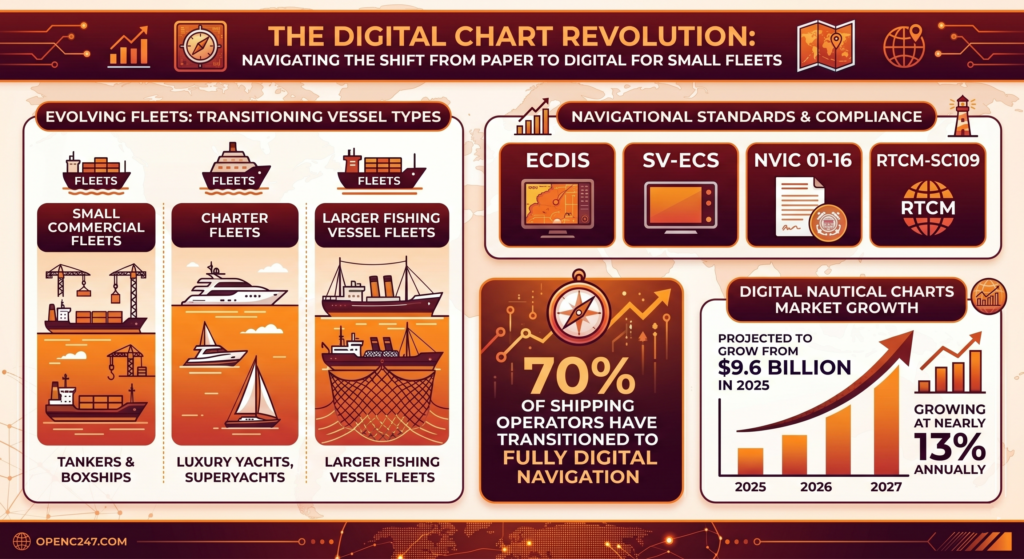
Small commercial fleets, charter fleets and larger fishing vessel fleets are adapting at pace. Of course, small fleets doesn’t necessarily imply smaller vessels, but for most this IS the case – and that makes a big difference in your approach to chart management.
* Paper chart prices have steadily increased, as have delivery costs.
The great digital transformation
Hydrographic offices are prioritising digital production
The trajectory is clear from the world’s leading hydrographic offices. The UK Hydrographic Office (UKHO) continues to produce paper charts (having reversed earlier plans to cease production), recognising their ongoing value. However, with over 23,000 official ENCs now available through services like AVCS compared to a more limited paper portfolio, the emphasis has decisively shifted to digital production.
The United States Coast Guard‘s decision through NOAA to transition from traditional lithographic printing to Print-on-Demand (POD) charts derived from digital files sent a clear signal: digital is now the primary format, with paper maintained as a derived product. This does not mean that there are no paper charts from NOAA. It just means that they will not stock the charts. They are still offered on demand and printed on the spot from selected distributors.
For small fleet operators, this presents both opportunity and challenge. While paper charts remain available through services like OpenC247.com – and we will continue to provide them – our focus, like that of our customers, increasingly centres on digital solutions that offer enhanced capabilities and simplified management.
Here at OpenC247 we fear paper charts will continue to be unprofitable for those who produce them. However Print on Demand charts remain reasonably strong, and distributors are able to offer charts from multiple hydrographic offices, but more and more charts are being removed from sale. UKHO is changing how they’re produced, and we anticipate them retaining a paper chart business for at least another 10 years.
The regulatory framework embraces digital while maintaining flexibility
Maritime authorities worldwide are explicitly embracing digital navigation for smaller vessels, while maintaining practical allowances for paper chart usage where appropriate.
The UK Maritime and Coastguard Agency’s introduction of Small Vessel Electronic Chart Systems (SV-ECS) represents a significant development. Under MGN 319 (M+F) Amendment 2, vessels under 24 meters – fishing boats, workboats, small commercial craft – can now use approved electronic chart systems to meet their SOLAS Chapter V obligations.
This isn’t about forcing technology on traditional mariners. It’s recognition that:
- Digital charts with automated updates offer enhanced safety features
- Smaller vessels benefit from access to modern navigational tools
- A flexible approach allowing both digital and paper serves the diverse fleet
Similar standards are emerging globally:
- The USCG’s NVIC 01-16 provides guidance on electronic chart systems for vessels not required to carry ECDIS.
- Norwegian Maritime Authority standards for fishing and small commercial vessels.
- RTCM-SC109 standards development for non-SOLAS vessels.
The message is clear: digital navigation is becoming the expected standard, while paper remains a valid option for specific operational needs.
The market reflects a strong but nuanced digital adoption
While regulations provide the framework, the market tells a more complex story. Recent industry analysis reveals:
For commercial shipping (deep sea fleets):
- Near-universal ECDIS adoption.
- Many vessels operate fully paperless bridges.
- Paper charts often retained only for contingency or company policy.
- 70% of shipping operators have transitioned to fully digital navigation.
For superyachts and smaller commercial vessels:
- Widespread use of ECDIS or ECS/chartplotters as primary navigation.
- Paper charts commonly retained as backup or for owner preference.
- Hybrid approaches balancing digital efficiency with traditional methods.
- Digital-first operations becoming the norm.
The digital nautical charts market is projected to grow from $9.6 billion in 2025 at nearly 13% annually, indicating strong continued growth in digital adoption.
Why paper charts persist alongside digital growth
Understanding why paper charts maintain their place helps operators make informed decisions:
Redundancy and failure modes: Electronics can fail due to power loss, hardware issues or cyber risks. Paper provides fail-safe backup that’s completely independent of ships’ systems.
Training and seamanship: Navigation training continues to include traditional chartwork and visual navigation skills. Many experienced mariners value maintaining these fundamental competencies alongside digital proficiency.
Regulatory edge cases: Some vessels or regions may lack full ENC coverage or operate with non-type-approved systems where paper charts provide regulatory compliance.
Operational preferences: Smaller vessels, particularly in familiar waters, may find paper charts sufficient for their needs, especially when combined with basic electronic aids.
The balanced benefits of digital chart adoption
For operators considering or expanding their digital navigation capabilities, the advantages are compelling:
Safety enhancements
Research consistently shows that integrated digital navigation environments:
- Reduce navigational errors through automated position plotting and alarm systems.
- Improve situational awareness by integrating AIS, radar and chart data.
- Decrease workload during critical operations.
- Enhance passage planning through route optimisation tools.
Operational efficiency
Digital systems eliminate the administrative burden of manual chart corrections while providing instant access to updated charts for any global destination. This is particularly valuable for vessels with unpredictable trading patterns.
Cost optimisation
While initial equipment costs exist, digital charts often prove more economical over time, especially for vessels that don’t require worldwide coverage. Pay-per-use models like OpenC247.com eliminate the waste of expensive annual subscriptions.
Environmental benefits
Digital delivery eliminates the carbon footprint of paper manufacturing, printing, and international shipping – a meaningful consideration for environmentally conscious operators.
The unique position of small fleets
Large shipping companies absorbed the digital transition years ago, with dedicated IT departments and standardised ECDIS installations. But small operators – those managing 1 to 20 vessels – face distinct considerations:
Diverse operational patterns: Unlike liner services with fixed routes, many small fleets operate in spot markets or seasonal trades. This makes flexible digital solutions particularly attractive compared to comprehensive paper chart portfolios or expensive annual digital subscriptions.
Mixed technology adoption: Small fleets often operate vessels of different ages and equipment standards. The ability to maintain hybrid paper-digital operations while gradually transitioning makes practical sense.
Cost sensitivity: Small operators need solutions scaled to their operations. Modern browser-based chart procurement offers enterprise capabilities without enterprise costs.
Digital solutions for every vessel type
The digital transition scales to match operational needs:
- Coastal cargo vessels benefit from reliable digital port approach charts.
- Fishing fleets can update coverage as grounds change seasonally.
- Charter yachts meet client expectations for modern navigation.
- Workboats navigate dynamic offshore environments safely.
Whether used as primary navigation or alongside traditional paper charts, digital solutions enhance operations without requiring wholesale abandonment of proven methods.
The practical path forward
The maritime industry presents a clear trend: digital navigation is becoming the primary standard while paper charts maintain their role as backup, training tools and primary navigation for specific vessel types.
Preparing for continued evolution
Smart operators are taking balanced approaches:
Immediate actions:
- Assess current chart management costs and workload.
- Evaluate digital solutions suitable for vessel size and operations.
- Consider hybrid approaches that maintain paper charts where valuable.
- Engage crews in planning the transition.
Building capabilities:
- Identify tech-savvy crew members as digital champions.
- Start with digital planning while maintaining paper execution.
- Document efficiency gains to justify further investment.
- Learn from peers successfully operating hybrid systems.
Avoiding common pitfalls
Don’t abandon paper charts precipitously if they serve your needs.
Don’t over-invest in complex systems designed for large ships.
Don’t ignore the genuine advantages digital systems offer.
Don’t get locked into expensive subscriptions that exceed your needs.
The evolving future of navigation
The digital chart revolution represents evolution, not extinction. Just as GPS supplemented rather than replaced visual navigation, digital charts are becoming the primary tool while paper maintains its place in the navigator’s toolkit.
For small fleet operators this transition offers opportunities to enhance operations without abandoning proven practices. The regulatory framework supports you. The technology has matured to meet diverse needs. The market validates the benefits while respecting traditional approaches.
Conclusion: charting your course in a digital age
The shift from paper-primary to digital-primary navigation marks a fundamental evolution in maritime operations. This isn’t about abandoning tradition – it’s about embracing tools that enhance safety and efficiency while maintaining the flexibility small operators need.
Whether you maintain paper charts as backup, operate fully digital bridges, or blend both approaches, the key is making informed decisions that serve your operational needs. Modern solutions like OpenC247 support this flexibility, offering digital advantages without forcing abandonment of paper where it provides value.
In Part 2, we’ll explore practical solutions for small fleets making this critical transition, including new browser-based approaches that eliminate traditional barriers to digital navigation.
Also read our article on small fleets charts costs and how to reduce them when you ‘chart smarter’.